
The “Ausbildung” Route for Lab Technicians in Germany in 2026
Estimated reading time: 12 minutes
🎓 What is the “Ausbildung” Route?
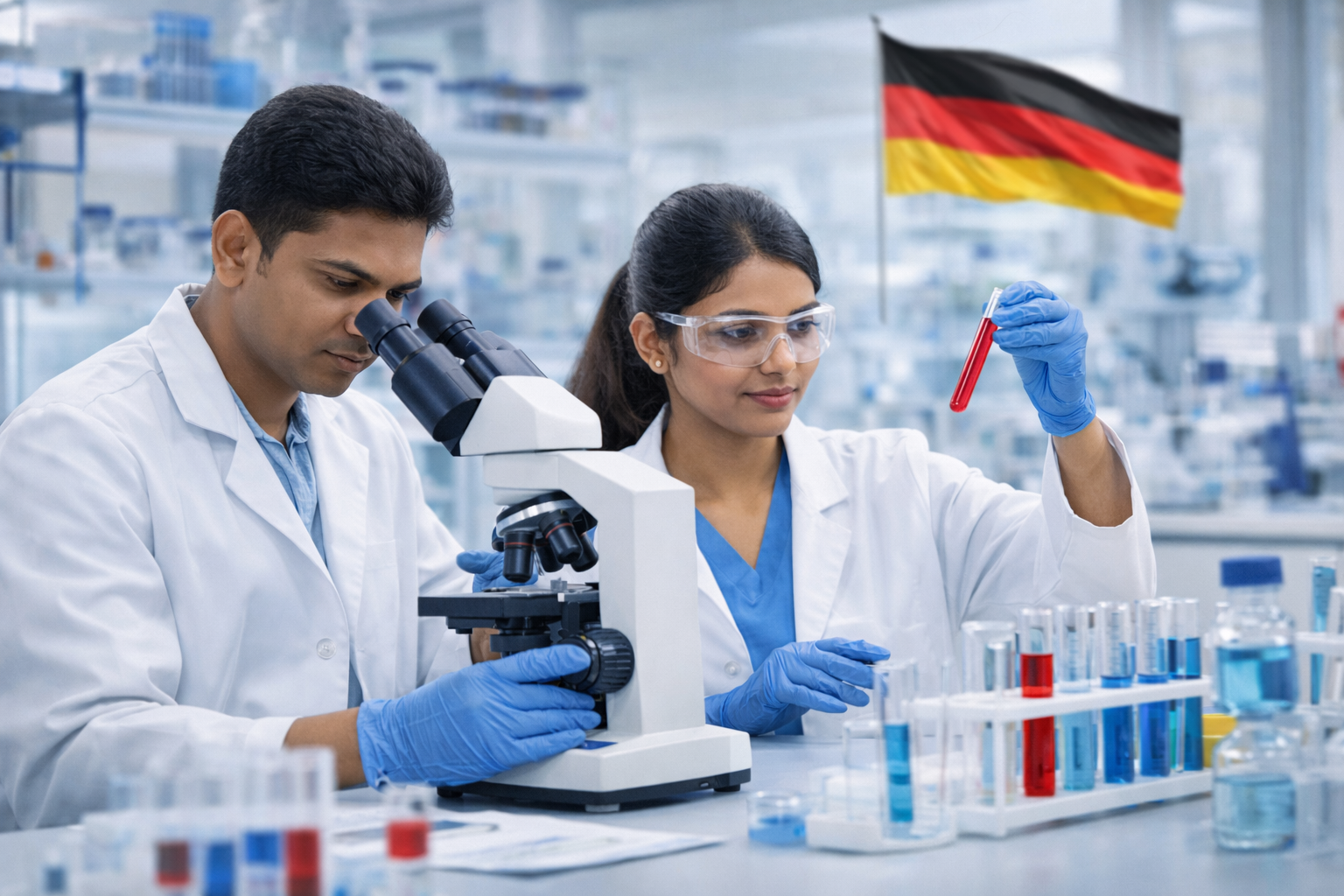
If you are a fresh graduate (Class 12) or lack a recognized degree, the Ausbildung (Vocational Training) is your best path. It is a 3-year dual program where you study at a vocational school and work in a hospital lab simultaneously.
The Best Part? It is tuition-free, and you receive a monthly salary (stipend) while you learn.
⚠️ Prerequisite: German Language
The training is conducted entirely in German.
- Requirement: B2 Level is standard (B1 is sometimes accepted for application, but B2 is needed to survive the coursework).
- Our Solution: Join our German Language Program. We prepare you specifically for the entrance exams and interviews conducted by German vocational schools.
https://lingothoughts.com/german-a1-beginner.html
📍 Step-by-Step Guide: The Ausbildung Route
Step 1: Eligibility Check
- Education: Minimum 10th grade (Mittlere Reife equivalent), but 12th grade (Science stream) is preferred.
- Age: Minimum 18. No upper limit, but usually for ages 18–28.
- Subjects: Strong grades in Biology, Chemistry, and Physics.
Step 2: Find a Training Position
You must apply to a hospital or lab that offers the training (search for Ausbildungsplatz MTL).
- Where to search: Ausbildung.de, Lehrstellenradar, or career pages of major clinic groups (e.g., Charité, Helios, Vivantes).
- Timeline: Apply 6–12 months in advance (programs usually start in August/September or March/April).
Step 3: The Contract & Salary (Stipend)
You are considered an employee, not just a student. Since 2023, salaries are standardized:
- 1st Year: ~€1,215 / month
- 2nd Year: ~€1,275 / month
- 3rd Year: ~€1,335 / month
- Note: This usually covers your living expenses in Germany.
Step 4: The Visa Process
Apply for a National Visa (Category D) for Vocational Training.
- Documents: Training contract (Ausbildungsvertrag), B2 Language Certificate, and proof of finances (your stipend contract usually serves as this proof).
Step 5: Graduation & Job Security
- Duration: 3 Years (3,170 theory hours + 1,230 practical hours).
- Certification: Upon passing the state exam, you are a fully qualified MTL (Medizinische Technologe).
- Prospects: nearly 100% employment rate. Most trainees are hired immediately by their training hospital. Starting salary after graduation is approx. €2,500–€3,000 gross/month.
Detailed MLT Ausbildung Route
If you’re a new graduate, lack a formal MLT qualification, or prefer to gain German credentials, pursuing an Ausbildung (vocational training) in Germany is an ideal route. Germany’s Ausbildung system is world-renowned, combining classroom instruction with paid on-the-job training. In 2023, the lab tech training was revamped and the official title is now Medizinische/r Technologe/in für Laboratoriumsanalytik (MTL), replacing the old MTLA title. Doing an MTL-Ausbildung in Germany leads to the same qualification that German lab techs have – a fantastic way to start your career with a recognized credential. Here’s a step-by-step guide for this route:
Ensure You Meet Eligibility Requirements: To enroll in an MTL vocational training program, you generally need a 12th grade or at least 10th grade education. The official requirement is a mittlerer Schulabschluss (middle secondary certificate) – Indian higher secondary (Class 12) is usually accepted as equivalent. You’ll need to get your school certificates validated/recognized by German authorities (this is often done through a simple application to convert your marks into the German system). Equally important, German language proficiency of B1–B2 is required for almost all Ausbildung programs. Many hospitals and vocational schools explicitly ask for a B2 German certificate for MTL training. This makes sense, as the courses are taught in German and you’ll interact with hospital staff during practical rotations. (Some institutions might accept B1 for application if you commit to reach B2 by start date, but aim for B2 to be competitive.) Other requirements include: strong science background (good marks in biology, chemistry, etc.) and sometimes basic English knowledge (since some scientific terms or textbooks might be in English). You must also usually be at least 18 years old; there’s no official upper age limit, but if you’re much older than typical trainees (who are in their late teens or early 20s), you’ll need to convincingly explain your motivation – age is not a barrier if you show commitment. Finally, you should be in good health (some programs ask for a medical check) to handle tasks like working with biological samples safely.
Search for Ausbildung Programs and Openings: Finding an Ausbildung position as a foreigner requires some research, but plenty of resources exist. The Ausbildung for lab technologists is offered by vocational schools, often affiliated with hospitals or laboratory companies. These schools usually collaborate with clinics or labs where you’ll do your practical training. To find openings, check the Federal Employment Agency’s portal (filter for Ausbildungsangebote or training positions for Medizinischer Technologe Labor). For example, a recent search shows an apprenticeship posting for MTL at a clinic in Bavaria, starting in September 2026 – indicating that even years in advance, positions are being advertised. You can also look at major hospital groups like Helios, Charité, Vivantes, etc., which often list “MTL Ausbildung” on their career pages. Another approach is sites like Ausbildung.de or Medi-Karriere, which list training programs; at one point, Medi-Karriere noted multiple open MTLA apprenticeship slots across Germany. German companies are increasingly open to international trainees because of domestic skill shortages, so don’t be discouraged. When you find a school or program, check their application deadlines – some start classes twice a year (spring or fall). Prepare your documents: translated and authenticated school certificates, German language certificate, a CV, and a motivation letter (explain why you want to train as an MTL in Germany – mentioning the advanced labs and your passion for science can help). If needed, reach out via email to the school’s admissions office; many will have dealt with international applicants and can guide you through any additional steps (like an entrance exam or interview, which could be conducted via video call).
Apply and Obtain a Training Contract/Admission: Once you apply, you might go through an interview process (in German) or sometimes a short test. Upon acceptance, you will receive either an Ausbildungsvertrag (training contract) if it’s a dual program or an admission letter from the vocational school. Unlike university admissions, an Ausbildung typically counts as a job contract because you will be an Azubi (trainee) employed by a company or hospital. The great news is that, since the 2023 reforms, Ausbildung is paid – you’ll receive a monthly stipend and no tuition is charged. For MTL trainees, the typical stipend ranges from around €1,200 in the first year up to €1,350 in the third year per month. (This can vary slightly by region or employer, but all states now ensure training pay. For example, one large hospital in Stuttgart pays about €1,215, €1,275, and €1,335 in years 1, 2, 3 respectively.) This stipend should cover a good portion of living expenses. Once you have the training contract/admission letter, you’re ready to tackle the visa.
Apply for an Ausbildung (Training) Visa: Germany allows non-EU citizens to come for vocational training under a dedicated visa category. With your contract/offer in hand, you will apply for a National Visa (D Visa) for the purpose of vocational training at the German Embassy or Consulate in India. Key documents will include your training contract or school admission, proof of your educational qualifications, German language certificate (they will definitely check your language ability for this visa), and proof of financial support. Usually, because the training is paid, showing the contract and the stipend amount may suffice as financial proof. However, if the stipend is considered not enough for all expenses, you might be asked to show additional funds or a Blocked Account to cover the difference (in practice, many MTL trainees can live modestly on €1200/month especially if housing is affordable or provided). The visa process for Ausbildung might also involve a quick check that your school is recognized and that you meet requirements – this is routine. Once approved (typically in a few weeks), you’ll get a visa to arrive in Germany and participate in the 3-year training program.
Complete the 3-Year Training in Germany: The Ausbildung itself lasts three years and is quite comprehensive. You’ll attend a Berufsfachschule (vocational school) for theoretical lessons and work in laboratories for practical experience. The curriculum will cover subjects like clinical chemistry, hematology, microbiology, histology, etc., with at least 3,170 hours of classes and 1,230 hours of practical training by law. It’s intensive, but you’ll gain cutting-edge skills and familiarity with German laboratory standards. During your training, you are also an employee, so you’ll enjoy benefits like paid vacation and social insurance. Use this time not only to learn lab techniques but also to immerse yourself in German – after three years of daily use, you’ll be near fluent. At the end of the program, you’ll take final exams (written, practical, and oral) to earn your qualification. Passing these exams grants you the professional license as an MTL in Germany. In other words, you become a fully qualified lab technologist, legally allowed to work without further tests.
Employment and Future Prospects: After completing the Ausbildung, you’ll find job opportunities readily available. Many trainees get job offers from their training hospitals or labs even before graduation, since employers are keen to retain talent. As a newly qualified MTL, you can expect a starting salary in the range of €2,500–€3,000 (brutto) per month depending on the region and sector. With some experience, salaries typically rise (public sector jobs follow pay scales – e.g., around €3,300+ after a few years). Beyond the first job, you have multiple career options: you can specialize in areas like histopathology or molecular diagnostics, pursue further studies (some MTLs go on to do a Bachelor’s in biomedical science or related fields), or even take on supervisory roles in labs. Importantly, your German qualification is recognized EU-wide, so you have the flexibility to work anywhere in Germany or even elsewhere in Europe. And if you enjoyed life in Germany, you can work toward permanent residency after a few years of employment. All in all, the Ausbildung route is a fantastic way to start fresh in Germany, with a clear structure, financial support during training, and a high chance of stable employment afterward.
Why choose the Ausbildung route? It’s perfect if you want a guaranteed pathway into the profession, even if you lack experience or if your foreign diploma isn’t easily recognized. You’ll end up with a German credential, strong language skills, and on-the-job experience. While it takes 3 years, remember that you are earning while learning, and the training is free of cost. Given the skill shortage, Germany has made this route very welcoming – effectively, you are paid to become a skilled professional in a high-demand field. For many young professionals from India, this is an attractive option to gain international experience and a valuable qualification.
PHASE 1: Eligibility & Preparation (6–12 Months Before)
Before applying, ensure your profile matches German standards.
- Academic Qualification:
- You must have completed Class 12 (Higher Secondary).
- Stream: Science (Biology, Chemistry, Physics) is highly preferred.
- Grades: Good marks (above 60-70%) in science subjects are crucial.
- German Language (The Most Critical Step):
- Complete A1 & A2 levels (Basics).
- Complete B1 (Intermediate) – Minimum requirement for applications.
- Complete B2 (Upper Intermediate) – Highly Recommended.
- Reason: Vocational school is taught 100% in German. Without B2, passing the entrance interview and coursework is very difficult.
- Document Translation:
- Translate your 10th and 12th-grade mark sheets into German.
- Use a sworn/certified translator.
- Tip: Check if your specific target state in Germany requires a “Zeugnisanerkennung” (official recognition of your school certificate) before applying.
PHASE 2: Job Search & Application (6–9 Months Before)
Ausbildung usually starts in August, September, or October. Apply nearly a year in advance.
- Prepare Application Documents (PDF format):
- CV (Lebenslauf): Must be in “Europass” or German tabular format. Include a professional photo.
- Cover Letter (Anschreiben): Written in German. Explain why you want to be a Lab Tech and why in Germany.
- Certificates: Attach your Language Certificate (B1/B2) and translated school transcripts.
- Where to Apply:
- Search specifically for: “Ausbildung Medizinische Technologen Laboratoriumsanalytik”.
- Portals: Ausbildung.de, Azubiyo.de, Bundesagentur für Arbeit.
- Direct: Check the “Karriere” (Career) pages of University Hospitals (Uniklinik) and large lab chains (e.g., Synlab, Helios, Charité).
- The Interview:
- If shortlisted, you will be invited for a video interview (Skype/Zoom).
- Practice: Be ready to introduce yourself in German and answer questions about why you like Biology/Chemistry.
PHASE 3: Contract & Finances (3–6 Months Before)
Once you pass the interview, you will receive an offer.
- Sign the Contract:
- You will receive an “Ausbildungsvertrag” (Training Contract).
- Check the Salary (Vergütung): Standard MTL salaries are approx. €1,215 (Year 1), €1,275 (Year 2), and €1,335 (Year 3).
- Chamber Registration:
- Ensure the employer has stamped the contract and registered it with the relevant authority (this stamp is required for the visa).
- Financial Calculation (The Blocked Account Check):
- Rule: You generally need proof of approx. €934–€1,000 per month (net) to secure a visa.
- Calculation: If your stipend (after tax/deductions) is lower than the required amount, you must open a Blocked Account (Sperrkonto) to cover the difference.
- Note: MTL stipends are often high enough that you might not need a Blocked Account, or only a small one.
PHASE 4: Visa Application (1–3 Months Before)
Apply for the National Visa (D-Visa) Section 16a (Vocational Training).
- Book Appointment: Schedule a slot at VFS Global or the German Mission in India immediately after signing the contract.
- Compile Documents (Original + 2 Copies):
- Valid Passport.
- Signed Training Contract.
- Language Certificate (B1/B2).
- School Certificates (Translated).
- Proof of Health Insurance (Incoming Travel Insurance for the first few weeks).
- Proof of Finances (The contract showing salary + Blocked Account if applicable).
- Motivation Letter.
- Visa Fee (Approx. €75).
- The Visa Interview: Be prepared for questions in German to verify your language skills.
PHASE 5: Arrival & Settlement
- Accommodation:
- Ask your employer if they have a “Schwesterwohnheim” (Staff Dormitory). This is the cheapest option.
- If not, search for “WG-Zimmer” (Shared flat) on WG-Gesucht.de.
- City Registration (Anmeldung):
- Register your address at the Bürgeramt (City Hall) within 2 weeks of arrival.
- Bank Account:
- Open a German “Girokonto” (Current account) to receive your salary.
- Health Insurance:
- Sign up with a statutory health insurance provider (e.g., TK, AOK). This is mandatory and deducted automatically from your salary.
Quick Summary of “Hard” Requirements
- Education: Class 12 (Science stream)
- Language: B2 German (Recommended), B1 (Minimum)
- Age: 18+ (18-28 is the ideal range)
- Money Needed: Flight ticket + Initial cash + Visa fees (The training itself is free & paid)
- Duration: 3 Years
- Outcome: State-recognized License (MTL) + Excellent Job Security
❓ FAQ: Ausbildung for Indians
Q: Do I need a Blocked Account?
A: If your stipend is high enough (approx. €900–€1000+ net), you often do not need a blocked account. The salary acts as your financial proof.
Q: Is the degree recognized globally?
A: Yes, the German MTL qualification is highly respected across the EU and worldwide.
🚀 Ready to Start?
Whether you choose the Direct Job route or the Ausbildung path, the journey begins with the German language.
https://lingothoughts.com/contact-us.html to enroll in our German B1/B2 batches tailored for medical professionals and secure your future in Germany’s healthcare sector.
Key Takeaways
- The Ausbildung Route for Lab Technicians in Germany offers a tuition-free, 3-year vocational training program that combines classroom learning and hands-on experience.
- A strong command of the German language (B2 level) is essential for the program, as all instruction occurs in German.
- Students receive a stipend during training: approximately €1,215 in the first year, increasing yearly, covering living expenses.
- After successfully completing the training and passing the state exam, graduates can expect high job security and starting salaries of €2,500–€3,000 per month.
- Qualification from this program is fully recognized across the EU, making it an attractive option for international students.

Related Posts

Is Japan Better Than Germany for Masters? (2026 Comparison Guide)

Are There Opportunities for Lab Technician Jobs in Germany for Indians?
