Basic German – What are the weekdays, months and dates in German?
Estimated reading time: 3 minutes
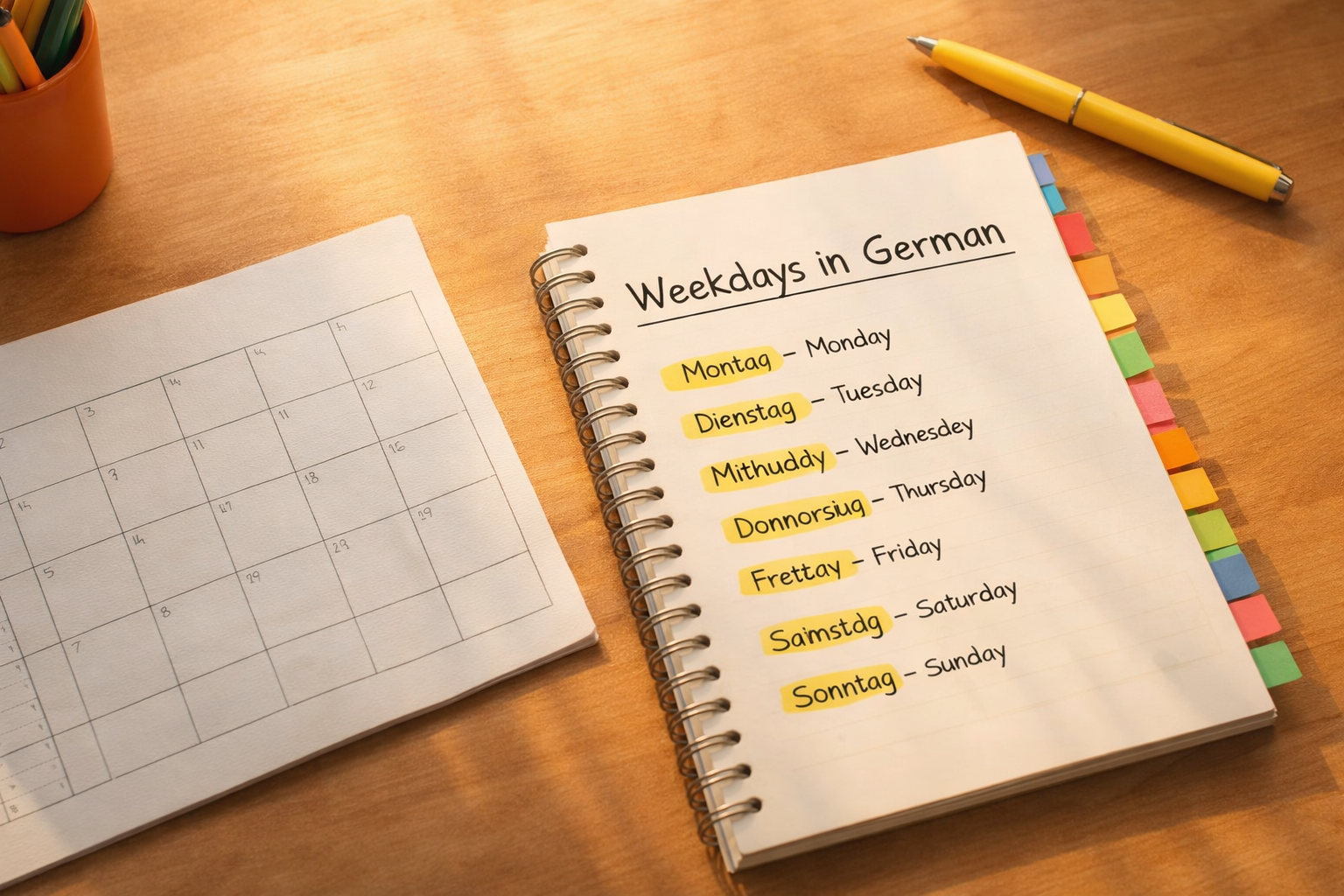
The weekdays in German are Montag, Dienstag, Mittwoch, Donnerstag, Freitag, Samstag/Sonnabend, Sonntag—and you usually use am with days and im with months when talking about dates.
Key Points (weekdays in german)
- German weekdays are capitalized because they are nouns
- Use am + weekday: am Montag
- Use im + month: im Januar
- For a specific date: am + ordinal + month: am 3. Januar
- The two “Saturday” words are both correct: Samstag (common) and Sonnabend (more regional)
If you’re starting from zero and want structure (not random vocabulary), Book a free trial class.
What are the 7 weekdays in German (with pronunciation tips)?
Here are the weekdays in German in a clean, copy-paste-friendly list.
| English | German | Pronunciation tip (simple) |
|---|---|---|
| Monday | Montag | “MOHN-tag” |
| Tuesday | Dienstag | “DEENS-tag” |
| Wednesday | Mittwoch | “MIT-vokh” (the ch is soft/rough) |
| Thursday | Donnerstag | “DON-ers-tag” |
| Friday | Freitag | “FRY-tag” |
| Saturday | Samstag / Sonnabend | “ZAHMS-tag” / “ZON-ah-bent” |
| Sunday | Sonntag | “ZON-tag” |
Quick teacher tip (why Indians stumble here)
In our beginner batches, many Indian learners pronounce Mittwoch like “Mit-woch” with a hard “ch”. The trick is: imagine the ch like the sound in “Bach” (a soft/rough air sound). That one small fix makes your speaking sound instantly more natural.
How do you say the months in German?
Months are also nouns, so they are capitalized.
| Month | German |
|---|---|
| January | Januar |
| February | Februar |
| March | März |
| April | April |
| May | Mai |
| June | Juni |
| July | Juli |
| August | August |
| September | September |
| October | Oktober |
| November | November |
| December | Dezember |
Fun fact (easy memory hook)
Juni and Juli are the most confusing for beginners because they look similar. I tell students: Juni ends with n like “next month”, and Juli ends with li like a “later holiday”. Silly, but it works.
How do you say dates in German (am vs im)?
This is where most beginners get stuck.
Rule 1: Use am with weekdays
- Ich habe am Montag Deutschunterricht.
- Wir treffen uns am Freitag.
Rule 2: Use im with months
- Ich bin im Januar in Deutschland.
- Die Prüfung ist im März.
Rule 3: For a specific date, use am + number
German often uses a dot after the number in writing.
- am 3. Januar
- am 15. August
Examples you can copy:
- Die Prüfung ist am 12. Februar.
- Ich komme am 1. Mai.
- Wir fahren am 20. Dezember nach Hause.
How do you ask “What date is it?” in German?
Here are beginner-safe questions and answers.
Questions
- Welcher Tag ist heute? (What day is it today?)
- Welches Datum haben wir heute? (What’s today’s date?)
Answers
- Heute ist Montag.
- Heute ist der 3. Januar.
Mini practice worksheet (save this section)
Fill in the blanks:
- Ich habe am ________ einen Termin. (Monday)
- Mein Geburtstag ist im ________. (March)
- Die Prüfung ist am ________. (15th August)
Answer key
- am Montag
- im März
- am 15. August
Best free practice resource for A1 beginners
If you want listening + reading practice around days and dates, Deutsche Welle’s Nicos Weg (A1) is one of the best free structured resources: https://learngerman.dw.com/en/nicos-weg/c-36519789
And if you want a full “start from scratch” path on LingoThoughts, see:
- Learn German (roadmap): https://lingothoughts.com/learn-german-language.html
- German language resources: https://lingothoughts.com/german-language-resources.html
How LingoThoughts makes this stick
We teach days/months/dates inside real situations: appointment booking, travel plans, exam scheduling, and daily routines. That means you don’t just memorize weekdays in German—you start using them automatically.
If you want the A1 structure + speaking practice, Book a free trial class.
FAQ
Are weekdays capitalized in German? Yes. They are nouns, so they start with a capital letter.
Do Germans say Samstag or Sonnabend? Both exist. Samstag is common; Sonnabend is more regional.
How do I say “on Monday” in German? am Montag.
How do I say “in January” in German? im Januar.

Related Posts

Is Japan Better Than Germany for Masters? (2026 Comparison Guide)
The “Ausbildung” Route for Lab Technicians in Germany in 2026