
How Can You Move to Germany as a Dentist?
Estimated reading time: 9 minutes
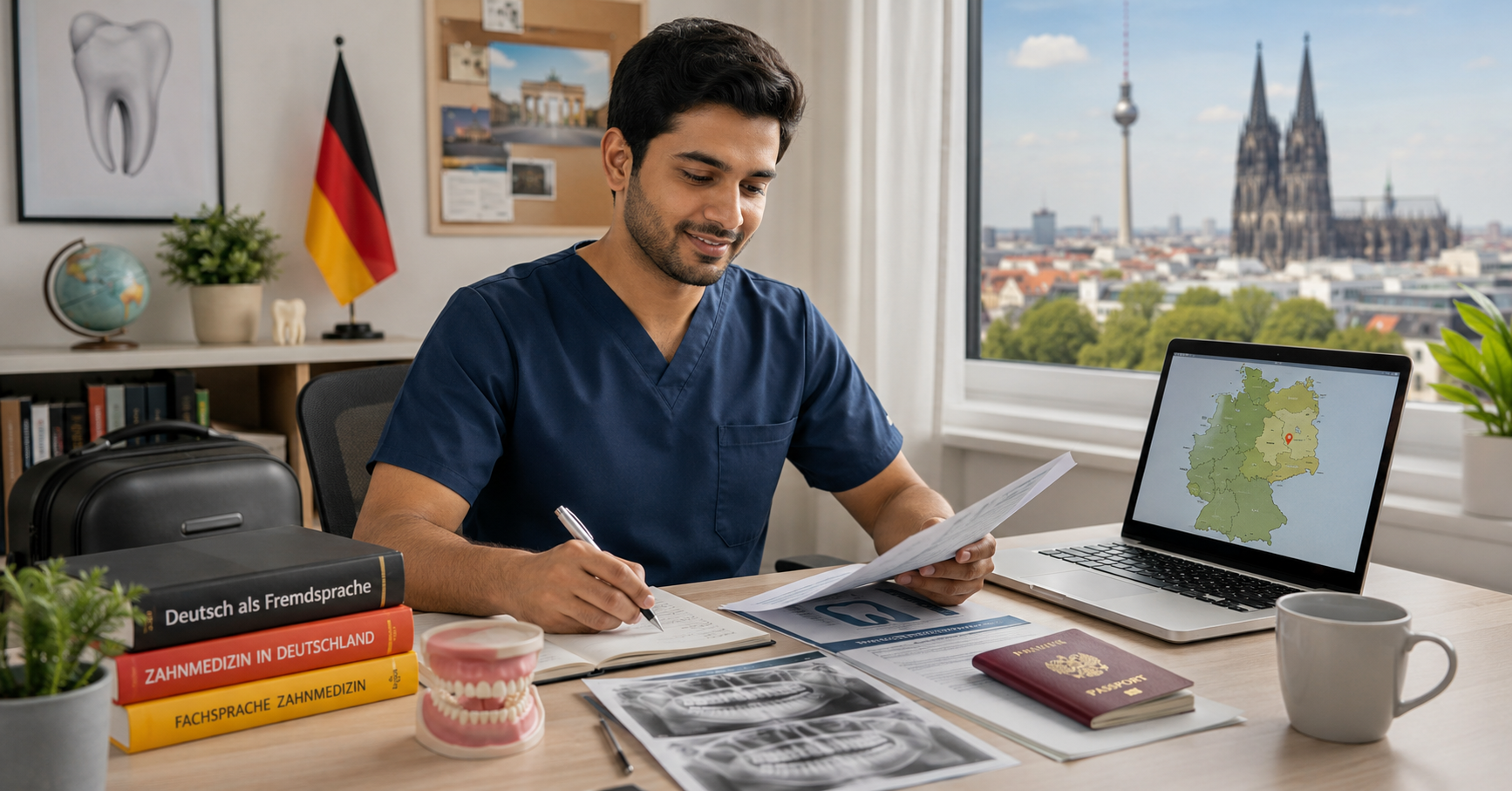
To move to Germany as a dentist, you need German language training, document preparation, professional recognition, and finally Approbation, the state licence to practise dentistry without restrictions.
For most Indian and non-EU dentists, the practical language path is A1 → A2 → B1 → B2 → C1 dental German/Fachsprachprüfung preparation.
Key Points
- Dentistry is a regulated profession in Germany, so you cannot work independently as a dentist without Approbation.
- You usually need B2 general German and a C1 specialist language test for the dental recognition process.
- A focused A1–B1 course is usually faster than a general Integration Course if your goal is professional recognition.
- After B1, dentists should move toward B2 German and dental-specific C1 communication.
- Start your German journey with LingoThoughts here: Book a free trial class.
Why does a dentist in Germany need Approbation?
A dentist in Germany needs Approbation because dentistry is a regulated profession. Approbation is the unrestricted state authorisation to practise dentistry and is mandatory if you want to work independently or open your own dental practice.
Your dental degree alone is not enough. Germany checks whether your foreign dental qualification is equivalent to German dental training. If the authority finds major differences, you may need to clear a knowledge examination.
For example, Berlin compares your foreign dental qualification with German training. If the qualification is not equivalent and the differences cannot be compensated through experience or additional proof, you may need a knowledge examination with written, oral, and practical parts.
Official source: Recognition in Germany — Dentist and Berlin Service Portal — Approbation as dentist
What is the fastest language path to move to Germany as a dentist?

The fastest language path to move to Germany as a dentist is usually:
- A1 German – basic survival German
- A2 German – daily-life conversations
- B1 German – independent communication
- B2 German – professional and formal communication
- C1 dental German – patient history, diagnosis explanation, documentation, and professional case discussion
At LingoThoughts, we usually advise dentists not to stop mentally at B1. B1 is an important milestone, but B2 and C1 dental language are where your career preparation becomes serious.
A common mistake we see is this: students spend too much time only collecting certificates. However, dentists need spoken confidence. You should be able to explain pain, swelling, treatment plans, consent, risks, medication instructions, and follow-up care in German.
Should dentists choose an Integration Course or A1-A2-B1 German classes?
For dentists, a focused A1-A2-B1 German course is usually better if speed and professional direction matter.
Integration Courses are useful for general settlement in Germany. However, they include broader topics such as German society, law, culture, history, and everyday integration. That helps many newcomers, but it may feel slow for a dentist who needs a recognition-focused language plan.
| Option | Best for | Speed until B1 | Dentist-specific value |
|---|---|---|---|
| Integration Course | General settlement, subsidised learning, daily life in Germany | Usually slower | Good for life in Germany, less targeted for dentistry |
| A1-A2-B1 focused German course | Professionals who want faster language progress | Usually faster | Better if speaking, grammar, exam prep, and B2 foundation are strong |
| B2 + C1 dental German | Dentists preparing for recognition | Needed after B1 | Highest relevance for Approbation and Fachsprachprüfung |
So, if you are still in India, start with a focused course like German A1 for beginners, then continue through A2 and B1 without long breaks.
If you are already in Germany and eligible for subsidised routes, you can still consider public options. However, keep your dental goal separate from general integration learning.
Which German level should dentists target before applying?
For licensing, many dentists should plan around B2 general German plus C1 professional dental language.
Berlin’s official service page lists B2 German knowledge and a technical language test as prerequisites for dentists trained in third countries. The recognition process also usually requires a specialist language examination at C1 level.
That does not mean you must wait until C1 before doing anything. In many cases, you can start document planning earlier. However, your real career readiness improves only when your German reaches the patient-facing level.
What documents does a foreign dentist usually need?
The exact document list depends on the German federal state where you apply. However, dentists commonly need:
- Passport or identity proof
- Dental degree certificate
- Transcripts or mark sheets
- Internship or clinical training proof
- Professional registration or licence from the home country
- Work experience certificates, if available
- Good standing certificate, if required
- Medical fitness certificate
- CV in German format
- German translations by sworn/certified translators
- B2 German certificate
- Proof of responsibility for the federal state, such as job applications, residence, or employer interest
Berlin lists documents such as application form, proof of responsibility for Berlin, CV, identity proof, birth certificate, evidence of completed education, and B2 German certificate for third-country dentists.
A practical tip from our teaching experience: prepare your German CV early. Even before B2, write simple German versions of your dental experience, procedures you handled, equipment you used, and departments you worked in. This builds vocabulary and helps later with interviews.
For German application documents, students can also read: German language classes and Learn German Language.
What happens after your documents are submitted?
After you submit your application, the authority checks whether your dental qualification matches the German standard.
There are usually three possible outcomes:
- Your qualification is equivalent
Then you move forward with the remaining requirements, including language proof. - There are differences, but experience may compensate
Your work experience and additional training may help. - There are major differences
You may need to take a knowledge examination.
The Berlin procedure explains that if equivalence is not proven and differences cannot be compensated, the dentist may take a knowledge examination. If the dentist passes and meets the other requirements, Approbation can be granted.
Can you work before full Approbation?
In some cases, yes, but with restrictions.
The Recognition in Germany procedure explains that third-country dentists may apply for an authorisation to practise a profession for a limited period. This can allow work under supervision by a person with Approbation, often in a specific area of work.
This can be useful if you are already in Germany and have an employer pathway. However, do not assume that it gives the same freedom as Approbation. It is temporary and restricted.
Which visa path can dentists consider?
Dentists whose qualifications are not fully recognised may explore the visa for recognition of foreign qualifications. Make it in Germany explains that this visa allows skilled workers to travel to Germany for steps needed to obtain full recognition, such as qualification measures, specialist training courses, preparatory courses, or job-related German courses.
Official source: Make it in Germany — Visa for recognition of foreign qualifications
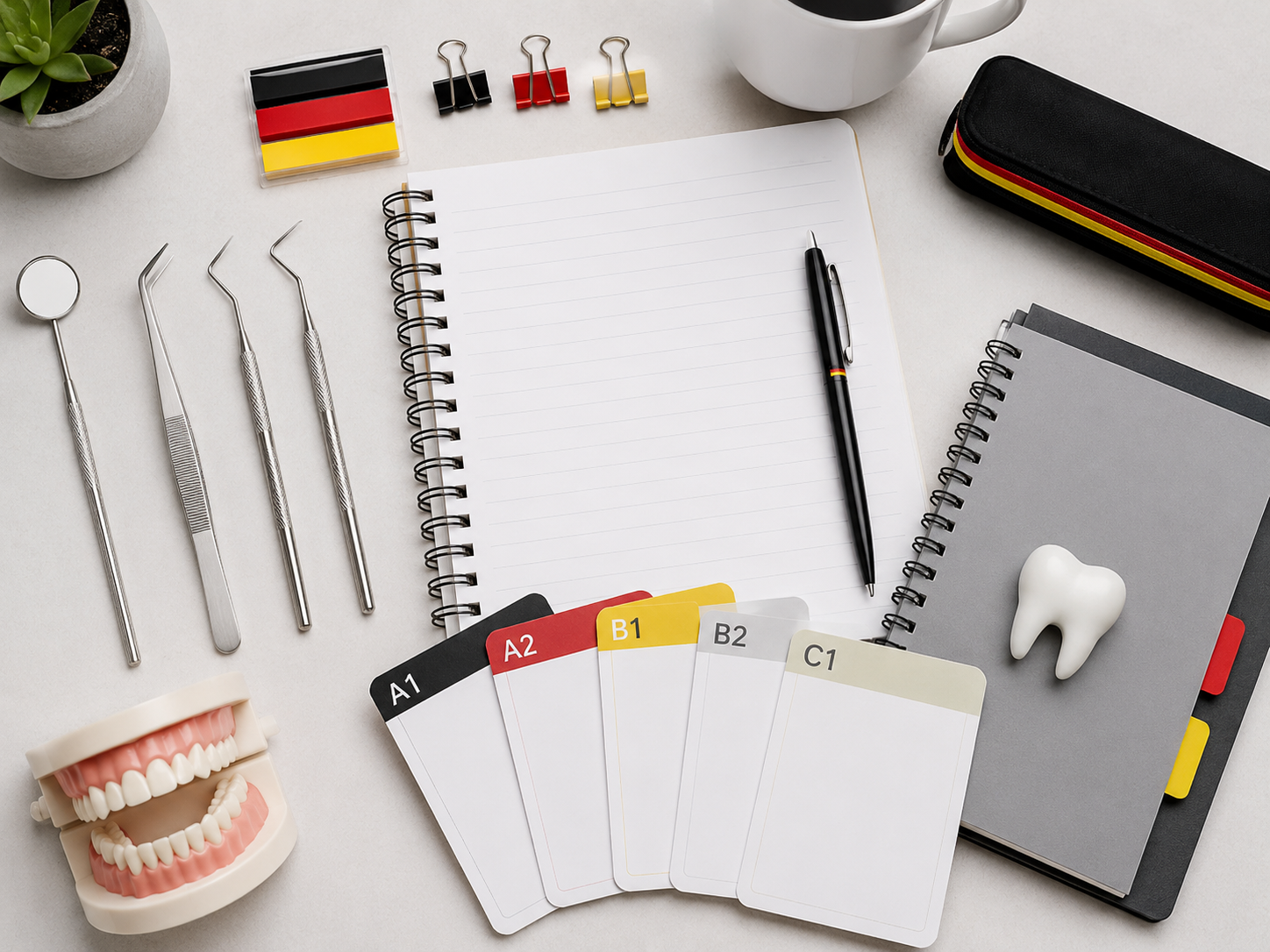
This is why your pathway should not be only “learn German and fly.” A stronger plan looks like this:
- Start German A1-A2 in India.
- Prepare documents and translations.
- Reach B1 or B2 depending on your timeline.
- Check the competent authority in the German state where you want to work.
- Apply for recognition or prepare for the recognition visa route.
- Continue B2 and C1 dental language.
- Prepare for Fachsprachprüfung and, if needed, the knowledge examination.
Should dentists learn general German or medical German first?
Start with general German first. Then add dental German after B1 or during B2.
At A1 and A2, you need grammar, sentence structure, pronunciation, listening habits, and confidence. If you jump too early into dental words, you may know Zahnfleischentzündung, but still struggle to say, “Since when do you have pain?”
A better method is:
- A1: daily life, introductions, numbers, appointments, basic questions
- A2: past tense, routine, symptoms, simple explanations
- B1: opinions, reasons, patient-style conversations, formal emails
- B2: clinical explanations, complex grammar, documentation
- C1 dental: patient history, case presentation, consent, treatment discussion
This is why our German language classes focus first on real communication, not only grammar charts.
How long can the dentist pathway take?
A realistic timeline depends on your starting level, study hours, and document situation.
| Stage | Practical target | Approximate focus |
|---|---|---|
| Month 1–3 | A1 | Basics, pronunciation, simple speaking |
| Month 4–6 | A2 | Daily life, past tense, appointments |
| Month 7–10 | B1 | Independent speaking, exam readiness |
| Month 11–16 | B2 | Professional German, formal writing |
| Month 17+ | C1 dental German | Fachsprachprüfung-style preparation |
Some learners move faster with intensive study. However, dentists should avoid rushing speaking practice. In dental recognition, weak speaking can delay your progress even if your grammar knowledge is good.
What should Indian dentists do before leaving India?
If you are an Indian dentist planning Germany, do these before moving:
- Start German immediately, ideally with a structured A1 course.
- Keep all dental education documents ready.
- Collect internship and work experience letters.
- Check whether your dental council registration and good standing documents are available.
- Decide which German state you may apply to.
- Begin learning German dental vocabulary from B1 onward.
- Avoid agents who promise guaranteed Approbation or guaranteed jobs without explaining recognition steps.
Also, compare your route with other healthcare pathways. If you are exploring nursing, healthcare, or Ausbildung routes for relatives or students, you can read LingoThoughts’ Germany-focused guide here: Learn German Language.
Who is this dentist pathway best for?
This path is best for:
- BDS or MDS graduates from India
- Dentists with clinical experience
- Final-year dental students planning early
- Dentists willing to invest 12–24 months in German and recognition preparation
- Healthcare professionals who want long-term career stability in Germany
It is not ideal for someone who wants a quick move without language learning. Germany needs healthcare professionals, but dentistry requires patient safety, clear communication, and formal recognition.
Summary: What is the best path to move to Germany as a dentist?
The best path to move to Germany as a dentist is to start with focused A1-A2-B1 German, then continue to B2 and C1 dental language while preparing your recognition documents.
Integration Courses can help with general life in Germany, but dentists usually need a more targeted route.
Start early, speak daily, prepare documents carefully, and treat German as a professional skill—not just a visa requirement. To begin the language journey, you can Book a free trial class with LingoThoughts.
FAQ
Can I work as a dentist in Germany with only B1 German?
No, B1 is not enough for independent dental practice. You usually need B2 general German and C1 specialist dental language for the recognition process.
Is an Integration Course enough for dentists in Germany?
An Integration Course may help you reach B1 and understand life in Germany, but it is not enough for dental licensing. Dentists should continue to B2 and C1 dental German.
Do Indian dentists need Approbation in Germany?
Yes. If you want to work independently as a dentist in Germany, you need Approbation. Germany checks your foreign dental qualification before granting it.
Can I apply for recognition from outside Germany?
Yes, in some cases you can apply from abroad. Berlin’s service page states that dentists can also apply for the procedure from abroad.

Related Posts

Is Japan Better Than Germany for Masters? (2026 Comparison Guide)
The “Ausbildung” Route for Lab Technicians in Germany in 2026