Study in Japan for Indian Students: Complete 2026 Guide

Estimated reading time: 4 minutes
Studying in Japan is a realistic and increasingly popular option for Indian students in 2026 — especially for engineering, IT, robotics, AI, and healthcare. With moderate tuition fees, strong industry links, and government scholarships like MEXT, Japan offers high ROI if you plan early and prepare for basic Japanese.
📌 Key Points at a Glance
- Around 1,300–1,600+ Indian students are currently studying in Japan, with targets to increase this significantly
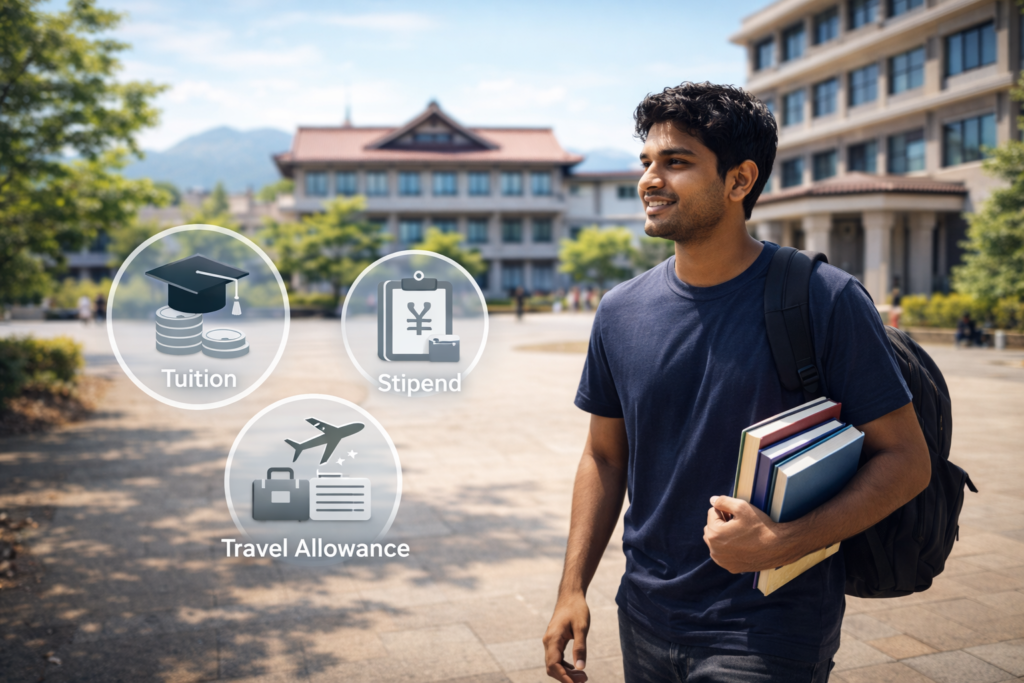
- Tuition ranges from ¥820,000–¥1.6M per year depending on university type
- Average monthly living cost: ~¥105,000 (₹60k–75k approx.)
- Students can work part-time up to 28 hours/week on a valid student visa
- MEXT and university scholarships reduce financial burden significantly
Why Study in Japan in 2026?
Japan is actively expanding its international student intake. According to recent official data, Indian student numbers dipped during COVID but are rising again, with policy targets aiming for 15,000 Indian students in the coming years .
Unlike some Western countries, Japan combines:
- Cutting-edge technology
- Strong job-market alignment
- High public safety
- Structured immigration pathways
Moreover, Japan currently has a labor shortage and over 2.3 million foreign workers — a record high — creating long-term career possibilities for graduates .
What Are the Tuition Fees in Japan?
Tuition depends on university type:
| University Type | Approx. Annual Tuition | INR Equivalent (Approx.) |
|---|---|---|
| National | ¥820,000 | ₹5.8–6 lakh |
| Public | ¥930,000 | ₹6.5–7 lakh |
| Private | ¥1.1M–1.64M | ₹7.8–11.6 lakh |
(Source: Government and education reports )
Compared to Germany (often tuition-free), Japan charges moderate fees. However, scholarships and tuition waivers make it competitive.
What Is the Cost of Living for Indian Students in Japan?
Average monthly expenses:
- Living expenses: ~¥105,000/month
- Tokyo rent alone: ~¥50,000–57,000/month
This roughly translates to ₹60,000–₹75,000 per month depending on city .
Students may work up to 28 hours per week, which helps offset costs .
Top Universities for Indian Students (Engineering & IT Focus)
Japan is globally strong in engineering, robotics, and AI. Leading institutions include:
- University of Tokyo
- Kyoto University
- Tokyo Institute of Technology
- Osaka University (Robotics)
- Tohoku University (AI & Data Science)
Many Japanese corporations like Toyota, Sony, and Fujitsu maintain partnerships with Indian institutions to build tech talent pipelines .
Are There English-Taught Programs in Japan?
Yes — but fewer than Germany.
Master’s programs in IT, robotics, data science, and engineering often offer English tracks. However, daily life and internships require basic Japanese.
Over 100,000 international students enroll in Japanese language programs in Japan .
Should You Learn Japanese Before Going?
Strongly recommended.
Even if your course is in English:
- Part-time jobs require basic communication
- Internships prefer JLPT N3 or above
- Long-term career growth requires N2/N1
Admission Requirements for Indian Students
Typical documents include:
- Academic transcripts & degree certificates
- IELTS/TOEFL (for English programs)
- EJU (for certain undergraduate programs)
- Statement of Purpose (SOP)
- 2–3 Letters of Recommendation
After admission, the university applies for your Certificate of Eligibility (COE).
For visa application, you need:
- COE
- Admission letter
- Passport
- Financial proof (₹12–15 lakh/year typical benchmark)
COE processing takes 4–8 weeks .
Scholarships for Indian Students
1. MEXT (Japanese Government Scholarship)
- Covers tuition
- Monthly stipend
- Limited slots per category (approx. 8–12 Indians per stream)
2. University Scholarships
Many universities offer partial tuition waivers.
3. JASSO Support & Indian Education Loans
Often combined for funding strategy.
Can You Work in Japan After Graduation?
Yes.
Japan allows students to switch to:
- Engineer/Specialist Visa (for IT, engineering, business roles)
- Specified Skilled Worker (SSW) visa (for sectors like caregiving, manufacturing, hospitality)
Japan hired over 50,000 foreign professionals in tech-related sectors in 2023 alone .
IT roles sometimes allow English-only positions, especially in Tokyo-based tech firms .
Japan vs Germany for Indian Students
| Factor | Japan | Germany |
|---|---|---|
| Tuition | Moderate | Often Free |
| English Programs | Limited | Many |
| Living Cost | ₹10–20L/year | ₹12–14L/year |
| Scholarship Access | Competitive (MEXT) | DAAD widely available |
| Language Importance | High for career | Moderate |
Japan is ideal if you want tech immersion + Asia career growth.
Germany is ideal if budget + English programs are priority.
Cultural Adjustment: What Indians Should Expect
Common observations by Indians in Japan:
- Extremely safe environment
- No tipping culture
- Public baths (onsen) are common
- Bowing instead of handshakes
- Slurping noodles is normal etiquette
Adjustment is manageable if you remain open-minded.
Is Japan Worth It for Indian Students in 2026?
Yes — if you:
- Want STEM-focused career growth
- Are willing to learn basic Japanese
- Plan finances carefully
- Aim for long-term work in Japan
Japan offers structured immigration routes, strong salaries compared to India, and world-class research infrastructure.
FAQs
1. How much bank balance is required for Japan student visa?
Typically ₹12–15 lakh per year as financial proof .
2. Can I study in Japan without Japanese language?
Yes for some English programs, but daily life requires basic Japanese.
3. Is Japan cheaper than Germany?
Germany often has no tuition, but living costs are similar.
4. Can Indian students get PR in Japan?
Yes, through Highly Skilled Professional or long-term work visa routes.
This guide is based on verified education, immigration, and government data sources including official Japanese education reports and embassy information .

Related Posts

Job Opportunities in Japan for Indians in 2026: What You Need to Know

Is Japan Better Than Germany for Masters? (2026 Comparison Guide)